a critical hardy-space contraction for the cubic chebyshev trace
blaize rouyea · corey bourgeois
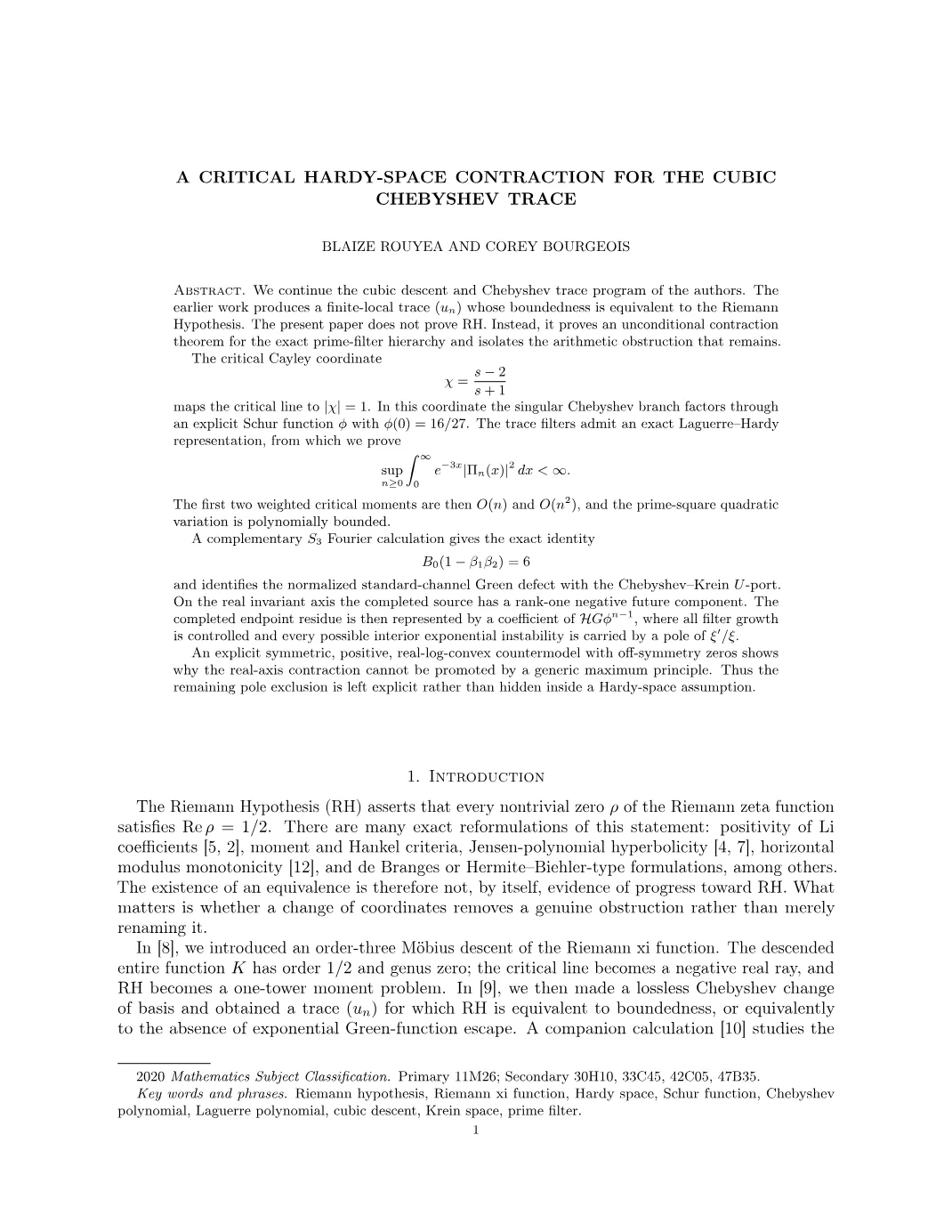
we continue the cubic descent and chebyshev trace program of the authors. the earlier work produces a finite-local trace whose boundedness is equivalent to the riemann hypothesis. the present paper does not prove rh. instead, it proves an unconditional contraction theorem for the exact prime-filter hierarchy and isolates the arithmetic obstruction that remains.
number theoryriemann hypothesishardy spaceschur functionchebyshev polynomialskrein spaceprime filters
a boundary-layer calculus for chebyshev prime filters
blaize rouyea · corey bourgeois
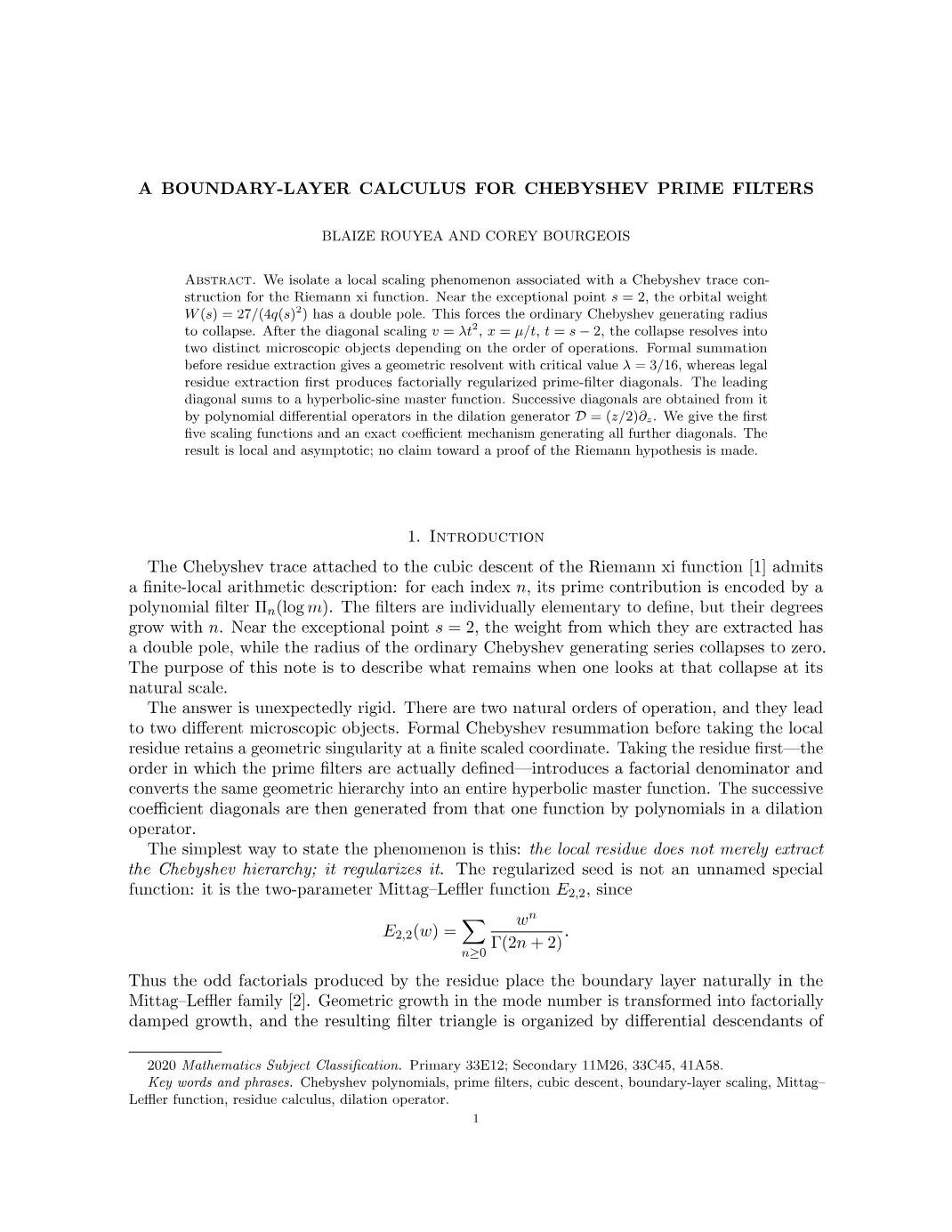
we isolate a local scaling phenomenon associated with a chebyshev trace construction for the riemann xi function. near the exceptional point s = 2, the orbital weight w(s) = 27/(4 q(s)^2) has a double pole, which forces the ordinary chebyshev generating radius to collapse. the collapse resolves into two distinct microscopic objects depending on the order of operations.
number theorychebyshev polynomialsprime filtersboundary-layer scalingmittag-leffler functionresidue calculus
the iota gateway: active evidence transport for neural weights
blaize rouyea · corey bourgeois
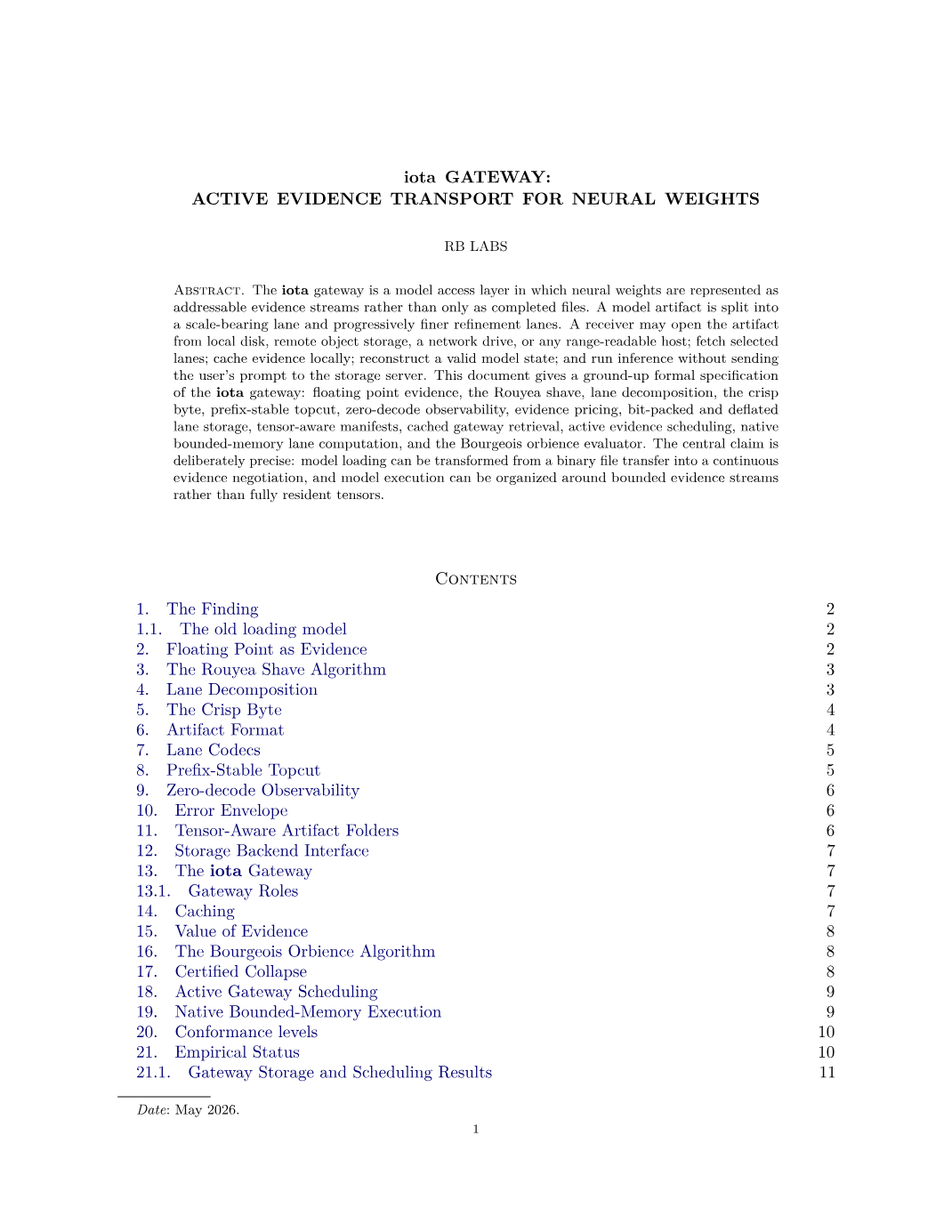
the iota gateway is a model access layer in which neural weights are represented as addressable evidence streams rather than only as completed files. a model artifact is split into a scale-bearing lane and progressively finer refinement lanes. a receiver may open the artifact from local disk, remote object storage, a network drive, or any range-readable host; fetch selected lanes; cache evidence locally; reconstruct a valid model state; and run inference without sending the user's prompt to the storage server.
neural inferencemodel compressiontensor storagestreaming inferencememory optimizationevidence theory
a chebyshev trace criterion for the riemann hypothesis
blaize rouyea · corey bourgeois
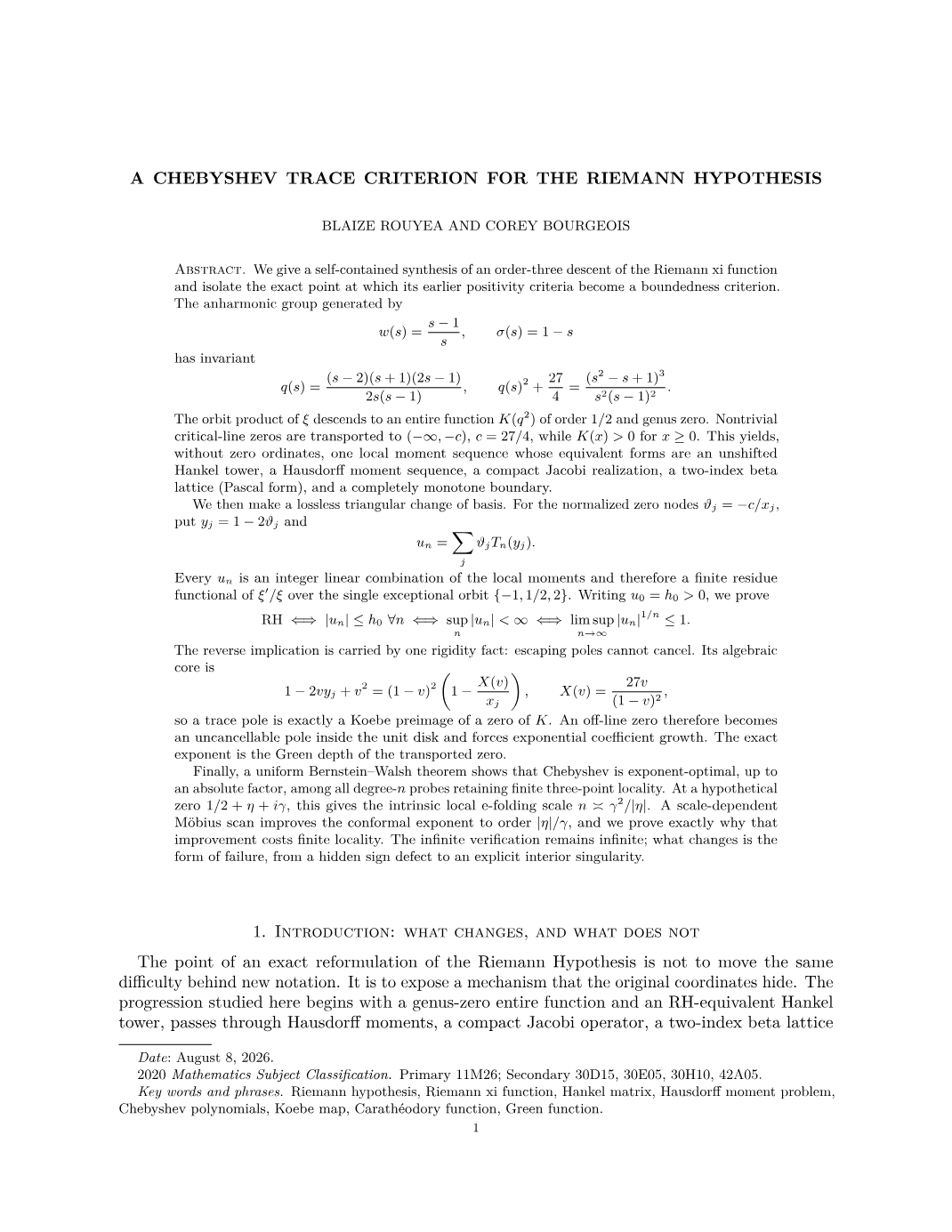
we give a self-contained synthesis of an order-three descent of the riemann xi function and isolate the exact point at which its earlier positivity criteria become a boundedness criterion. the orbit product of xi descends to an entire function of order 1/2 and genus zero, yielding a local moment sequence equivalent to a hankel tower, a hausdorff moment sequence, a compact jacobi realization, a two-index beta lattice, and a completely monotone boundary. a lossless triangular change of basis then produces a chebyshev trace whose boundedness is equivalent to the riemann hypothesis.
number theoryriemann hypothesisanalytic number theorychebyshev polynomialsmoment problemscomplex analysis
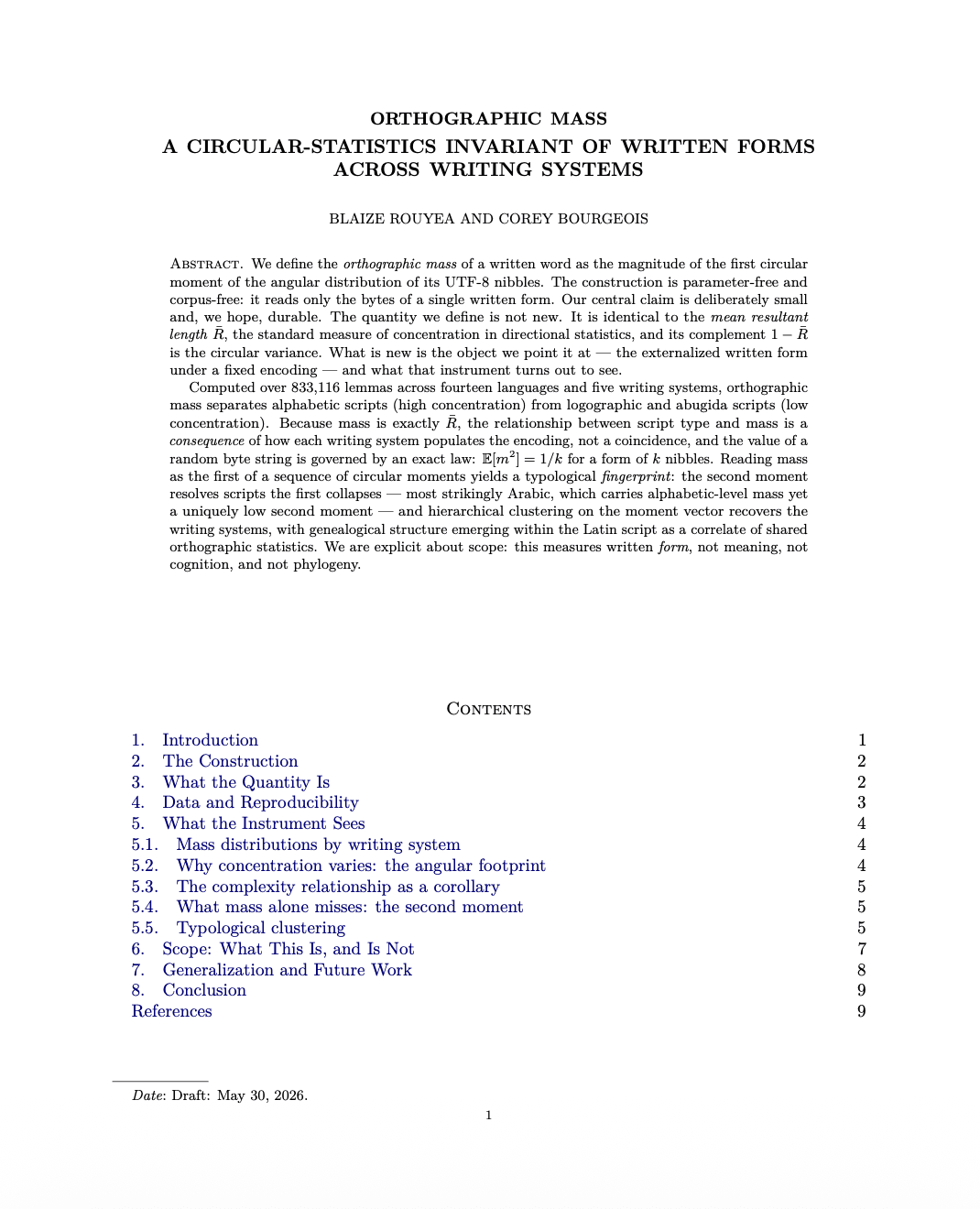
orthographic mass: a circular-statistics invariant of written forms across writing systems
blaize rouyea · corey bourgeois
we define the orthographic mass of a written word as the magnitude of the first circular moment of the angular distribution of its utf-8 nibbles. the construction is parameter-free and corpus-free: it reads only the bytes of a single written form. computed over 833,116 lemmas across fourteen languages and five writing systems, orthographic mass separates alphabetic scripts (high concentration) from logographic and abugida scripts (low concentration).
circular statisticsdirectional statisticsorthographywriting systemsUTF-8linguisticstypology
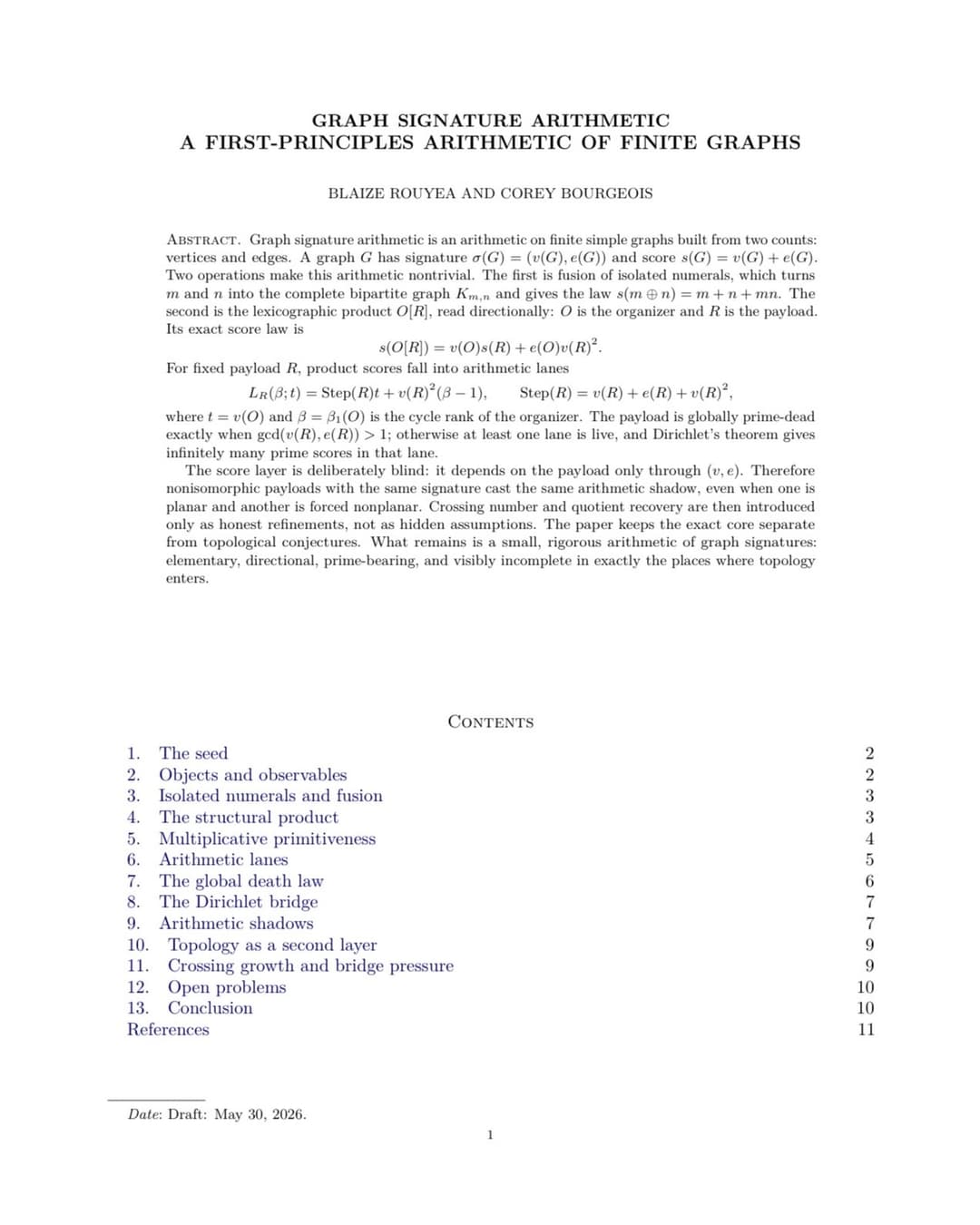
graph signature arithmetic: a first-principles arithmetic of finite graphs
blaize rouyea · corey bourgeois
graph signature arithmetic is an arithmetic on finite simple graphs built from two counts: vertices and edges. a graph g has signature σ(g) = (v(g),e(g)) and score s(g) = v(g) + e(g). two operations make this arithmetic nontrivial: fusion of isolated numerals (turning m and n into the complete bipartite graph k_m,n) and the lexicographic product o[r]. product scores fall into arithmetic lanes, and dirichlet's theorem gives infinitely many prime scores in live lanes. the score layer is deliberately blind to topology — nonisomorphic payloads with the same signature cast the same arithmetic shadow.
graph theoryarithmeticprime numberscombinatoricsdirichlet theoremcrossing number
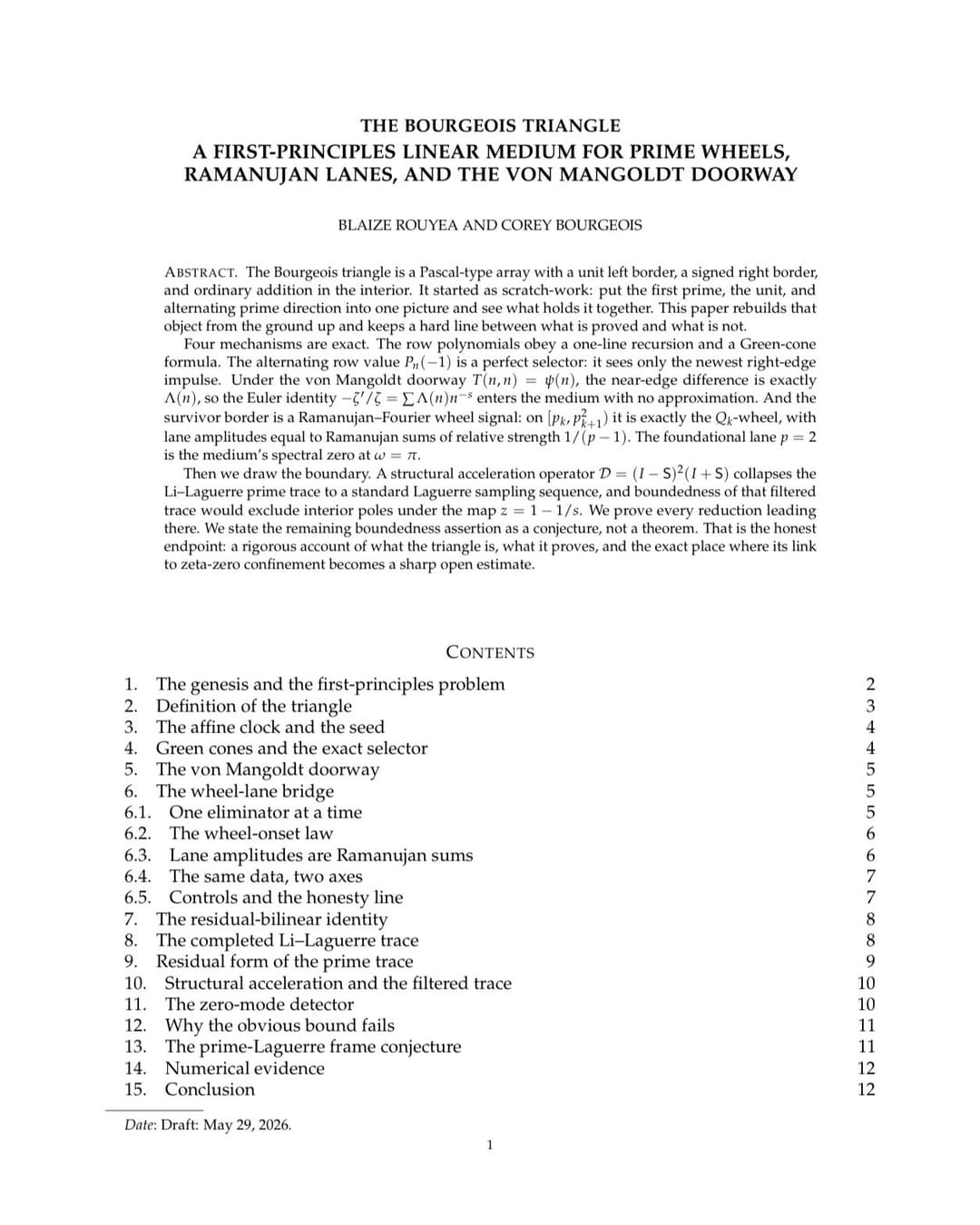
the bourgeois triangle: a first-principles linear medium for prime wheels, ramanujan lanes, and the von mangoldt doorway
blaize rouyea · corey bourgeois
the bourgeois triangle is a pascal-type array with a unit left border, a signed right border, and ordinary addition in the interior. four mechanisms are exact: row polynomials obey a one-line recursion and a green-cone formula, the alternating row value is a perfect selector, the von mangoldt doorway places psi(n) on the diagonal with near-edge difference exactly lambda(n), and the survivor border is a ramanujan-fourier wheel signal with lane amplitudes equal to ramanujan sums.
number theoryprime distributionramanujan sumsanalytic number theoryzeta functionli coefficients
lane-partitioned tensor storage
blaize rouyea · corey bourgeois
we present iota, a lane-partitioned tensor format that splits bf16 weights into significance-ordered lanes. this separation enables o(1) precision surgery, zero-cost entropy sensing, and budgeted lane-aware loading — streaming a 29.5gb model at 78mb rss on raspberry pi 5.
neural inferencecompressionmemory optimization
entropy-guided adaptive precision
corey bourgeois · blaize rouyea
entropy density transitions from metric to control signal. the same signal guides decode cost, keep level, sleeping, promotion, and demotion — at both training and inference time. training with entropy-budgeted precision recovered 92% of the gap between full precision and naive quantization.
precision controlentropytraining optimization
rouyea shave
blaize rouyea · corey bourgeois
shave removes significance waste by projecting weights onto their natural significance manifold. combined with cast (orientation waste) and drift (relational waste), these three projections expose the real structure hiding in trained neural network weights.
weight normalizationmodel compressionlocal-law
bourgeois orbience
corey bourgeois · blaize rouyea
lattice moves iota toward shared structural prototypes. store blocks as anchor + prototype + orbit + optional residual. compute directly from compact structure instead of reconstructing every weight — the goal shifted from rebuild-then-compute to compute-from-structure.
structural inferencelattice executioncompute optimization